
Why is oil analysis something you should do regularly?
Imagine being able to look inside your machines' engines and get a snapshot of their condition. In other words, a kind of condition report that tells you whether your machines are working optimally, or whether there are any irregularities to be found.
That is exactly what you get with an oil analysis.

Avoid machine breakdowns
Just as we humans benefit from a health check every now and then, so do machines. In fact, the vast majority (up to 70%) of machine breakdowns could have been avoided with regular oil analysis and preventive measures.
Unfortunately, far from all companies have set up an oil analysis programme and have the condition of their oil checked regularly.
What are the benefits of oil analysis?
It may sound too good to be true, but keeping track of the condition of the oil in your machines can actually turn out to be good business. But how? Here are some of the answers.
1.
Extend the service life of your machines
Oil is the "lifeblood" of your machines. It lubricates, cools and cleans the components, helping to ensure that the machines run efficiently and with minimal wear. In the same way that blood tests can reveal signs of illness in humans, oil analysis can reveal irregularities in your machines. It almost goes without saying that the sooner you detect signs of irregularities, the better.
Oil analysis can, for example, reveal early signs of wear or contamination before they lead to downtime. This means you can anticipate situations that could result in more serious damage. In this way, preventive action can extend the service life of your equipment.
2.
Optimise the performance of your machines
Oil analysis is not only about extending the service life of your machines, but also about making sure they always run at optimal performance. When you check the oil regularly and make sure it is clean and free of contaminating particles, your machines work more efficiently. This results not only in fewer unplanned breakdowns, but also in more stable and economical operation.
3.
Prevent machine breakdowns
If you have experienced it, you will know that unexpected machine breakdowns can be expensive, not only in repair costs but also in lost productivity. With oil analysis, you can, for example, detect early wear in bearings or components before it develops into downtime. That way, you can address early signs of weakness before they cost you a breakdown.
4.
Save on unnecessary oil costs
When you monitor your oil regularly, you gain insight into when it is time to change it. This can help you optimise your oil change intervals, so you change the oil neither too early nor too late. In other words, you only change the oil when necessary, which reduces both your oil purchases and the amount of waste oil. This saves you money on the bottom line, and benefits the environment too.
Easy oil sampling with a QR code
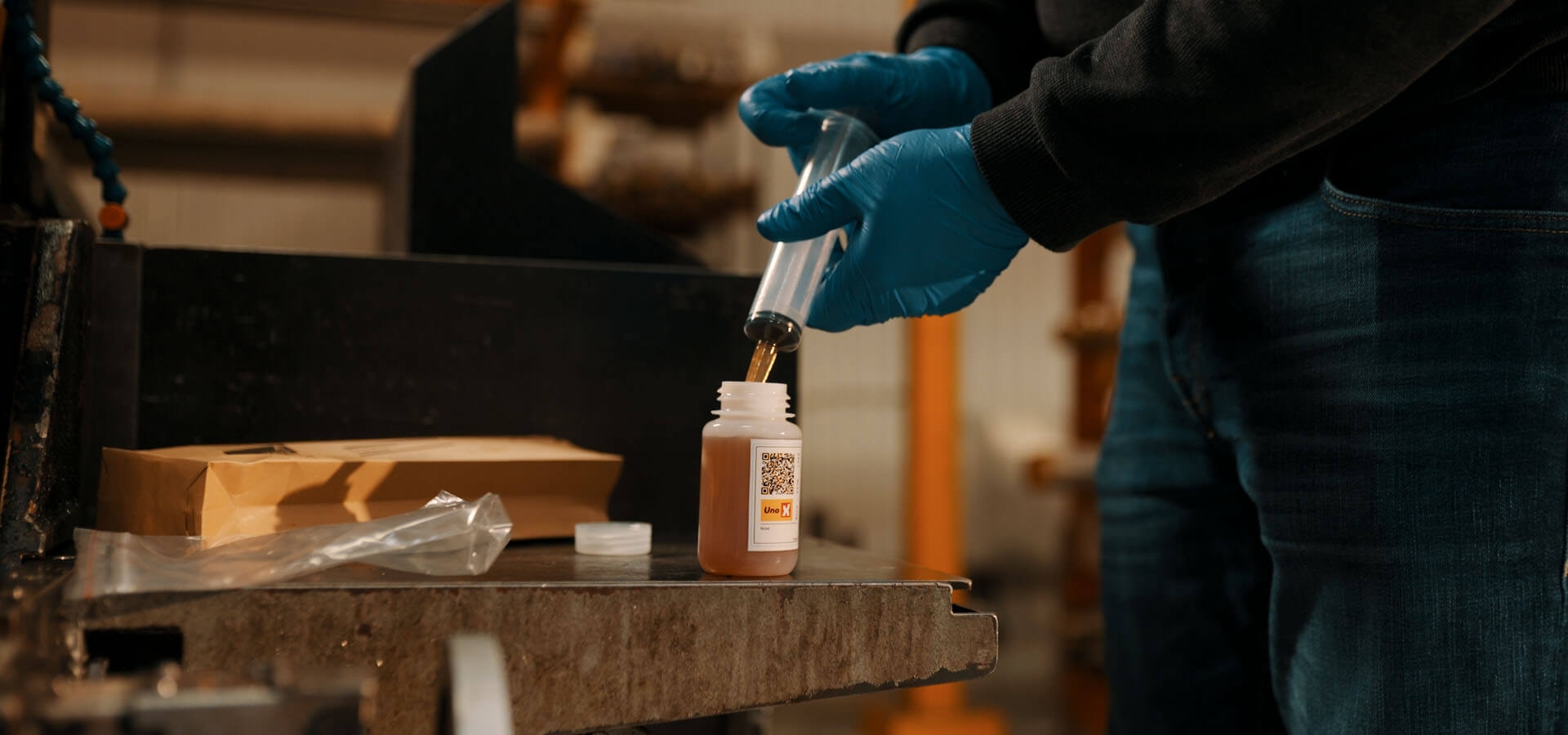
Registering an oil sample is easy and only takes a few minutes. A sample is taken from the machine using the (Uno-X/MainTest) analysis kit. Scan the QR code on the bottle with your smartphone, follow the link and enter the LabID that belongs to the machine. You are guided through the process, and in a few clicks the sample is registered. You can also register via PC: go to maintest.dk and enter the 12 characters next to the QR code, and you are ready to go!
Send in the sample, and you will receive an analysis report 3 to 5 working days after the laboratory has received it.
Why set up an oil analysis programme?
If you do not have a fixed system for when to take oil samples, it is often forgotten and only happens sporadically, and perhaps too late to respond to symptoms. It is also essential to have historical data to compare your oil analyses with. If you take oil samples regularly, you will quickly spot changes compared with previous analysis results.
Are you wondering how often you need to take oil samples and have them analysed? There is no simple answer. It depends on how important the machines are to your operations, and how serious the consequences of downtime and breakdowns would be. Our recommendation is at least 1 to 2 times a year, and preferably 2 to 4 times a year.

What does oil analysis cost?
The price of oil analysis depends on the product and application you want analysed. But at the end of the day, it is also wrong to look at the price in isolation. You should see oil analysis as an investment in a longer service life for your machines and more efficient operation.
In summary:
Oil analysis is an investment in the future of your machines
So oil analysis is not just another cost, even though it may seem that way in the short term. Of course, test equipment, oil samples and oil analyses cost time and money, but it is money you earn back through fewer unexpected downtimes and more efficient production. In short, it is about being proactive rather than reactive.
Find out more about oil analysis and get expert input on choosing the right analysis and interpreting test results.
You can always contact us by email or phone.